Yarra Plenty Regional Library services the outer municipalities of Nillumbik, Whittlesea and Banyule in the north of Melbourne, Victoria, Australia.
This blog informs our community about current events, resources, including websites that can assist an Australian family history researcher with their research. It is has been operating since 2006 and is managed by the Local and Family History Librarian.
Follow me on Twitter @Infolass
Showing posts with label "National Family History month". Show all posts
Showing posts with label "National Family History month". Show all posts
Professional genealogist Joy Roy recently presented at Diamond Valley Library as part of our Family History Month program 2019. InSearching for John Smith,Joy discussed her research journey to find her man in Scotland. Her challenge? SMITHisthe most common name in Scotland.
General tips from her discussion included:
Names. Look for a middle name. Perhaps your ancestor’s middle name was a family name (in the case of Joy and many with Scottish ancestry, Scottish naming patterns may be in place)
Place. Know the specific place your ancestor was associated with. Look at maps and be familiar with surrounding place names at the time your ancestor lived. Explore local history and seek out local publications for mention of your ancestor (and websites).
Online searching. Always include a location in your online searching to help filter your search results.
Occupation. Ascertain occupation via census records, city directories or obituary.
Cemeteries. Explore cemeteries in person and/or online and/or published index to find final resting place. A gravestone inscription or burial record can lead to researching other family members (or even people buried in the same location but who may or may not be related) an obituary or more.
Newspapers. Newspaper Research for your family history via British Newspapers Archive, Find My Past and Trove add life to your ancestors story. Obituaries are especially valuable and look at all versions when copied to other papers. Some may be longer than others.
Get distracted. Going on tangents can be fruitful. Joy’s ancestor was in charge of a prison. She researched the prison including its correspondence files to understand more of John’s life.
Family. Widen your search to include other family members. John can be found as a witness to a marriage or an informant for a death for example.
Criminal activity. Follow up on suspected criminal activity as a “bad” John Smith can be easier to locate in these types of records.
You can find your John Smith with patience and a lot of effort. Your search can be successful.
Kids can have fun learning about their family history and where they have come from. We have pulled together a list of activites and ideas that families can enjoy together.
Age Guide: Primary School
Scavenger Hunt Game (pre-schoolers can join in this one)
Family History is everywhere. Have a scavenger hunt in your house to see how many things you can find that are about your family history. You can look for a family bible, old papers and photos and scrapbooks, medals and jewellery or anything that reminds you of the past. If the items are moveable you can make a display, and if not, you can take and print photos or share online with other other family members. Create a name for your "family history museum," and ask mum and dad to tell you stories about the items and the relatives associated with them. Write these down or video or audio record them.
Gather Stories
Talk to parents and grandparents and ask them them about what they know about your family history. Write these down in a special keepsake book or journal, where you can add other information as you find it. Or video or audio record the stories.
The City of Whittlesea “Googling Grandparents” project aims to collect and share stories inviting children, grandchildren, carers, interested friends or community members to “interview” an elder, record the story and send it to Council for sharing in the future. Scroll down on the Council's Cultural Heritage page for more information.
Who’s Who Game. Have fun finding out "who's who" in a family tree.
Scrapbook copies of heritage photos.
Create a family tree
After talking to your relatives, fill in your names on a paper tree or chart. Printable PDFs include Fill Your Family Tree, or My Family Tree includes space for photos or drawings. Check out this colour-in version. This decorative My Family Tree includes information to record dates and places of birth. If you would like to record family information, download the My Family Group Record chart from FamilySearch.
How are you related? Check out this cousin chart to see how your cousins are connected to you.
Older kids may like to choose a free chart to download and fillout and print on your computer. If you are 13 years or older, you can create a free online tree on FamilySearch.
This weekend we celebrate our Family History Festival through a series of blog posts.
On Saturday 15 August we acknowledge the 75th anniversary of the end of World War 2. Japan accepted the Allied demand for unconditional surrender on 14 August 1945. For Australians, it meant that the Second World War was finally over. The following day, 15 August, is usually referred to as Victory in the Pacific (VP) Day. Almost one million Australians served during the Second world war. It is a time to pause, reflect and acknowledge the service and sacrifice of more than 39,000 who lost their lives and to remember those who made their contribution in service on the home front.
Local History
Did you know that the Diamond Valley Learning Centre, Greensborough, formerly tea rooms was a training station for Air Raid Precaution (ARP) wardens volunteers during WW2?
The Homefront sculptures at Greensborough War Memorial Park include the story of leading seaman Lionel Tasman Clarke
The Eltham War Memorial Complex at 903-907 Main Road, Eltham was built as a result of the community seeking an appropriate form of memorial ‘which will be a constant reminder to us of those who fought for us and the little ones for whom they fought and died.’ Learn more via the Eltham District Historical Society
Warrandyte Diary has published the story of local Stan Bisset who served at Kokoda
The Yarrambat War Memorial Hall which officially opened on August 25th, 1950 and the Yarrambat War Memorial Park acquired soon after WW2 by the City of Heidelberg Council are included on the Victorian War Heritage Inventory.
Ivanhoe Grammar School has an Honour Roll which records the names of service personnel in the Second World War
Street names in the Olympic Village, West Heidelberg were named for WW2 battles including Alamein and Midway.
Watch and Listen
A commemorative service will be televised from the Australian War Memorial on Saturday 15 August commencing at 10.00am. Listen to this special podcast about VP Day and explore more via their website
The Shrine of Remembrance is inviting people to their service which will be live streamed via their Facebook page. Sunday 15 August, 11.20am.
The Department of Veterans’ Affairs have been publishing their 75 days, 75 stories featuring veterans in their own words sharing their experiences
The Anzac Portal tells the history of Australians serving in the defence forces though veterans’ experiences. A number of history publications, war history websites, a digital exhibition and veteran interviews provide a greater understanding of Australia’s wartime experiences, both on the frontline and on the home front. Includes resources for students.
Browse issues of Mufti digitised by State Library Victoria. Mufti (1934-2000) was issued by various Returned Services Leagues organisations. Monthly issues include accounts of battles, feature articles and honour rolls for Anzac Day and Remembrance Day each year, commentary on political news of importance to members of the day, plus news from Victorian sub-branches, biographies and obituaries of members.
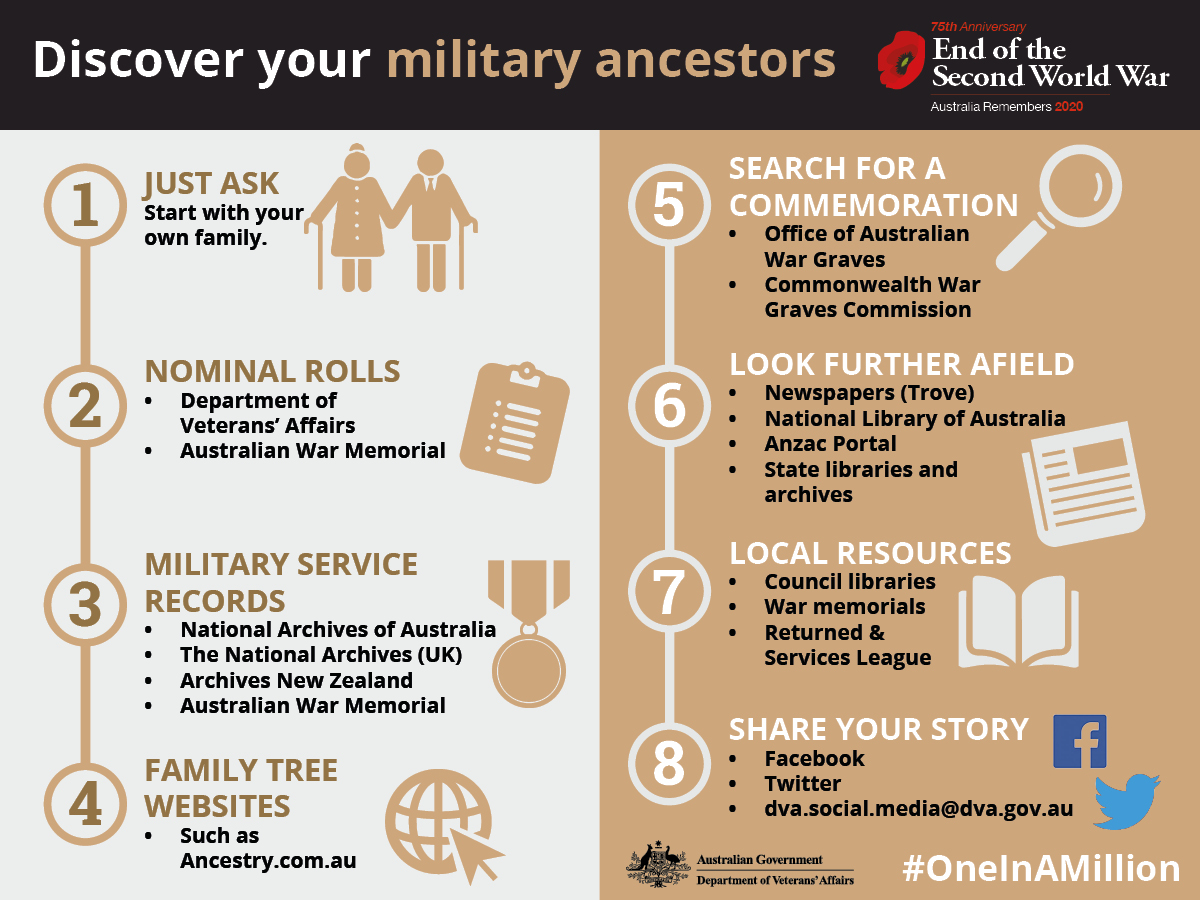
To find out more about your own WW2 ancestor or relative, ask family members what they know and look for records in the family, including photographs that may provide clues. If you cannot find a death registration that would fit the time period, this could indicate that your relative died in the war.
The National Archives of Australia hold service records. These include personal details, enlistment details, postings, leave taken, injuries and illnesses. Many files have now been digitised and are available on line via the RecordSearch function, if not a request can be made to order a copy.
The Australian War Memorial website is well worth a visit. They have a unique collection of art, photographs, film, sound recording and private records. Search by name or unit. Browse their blog and encyclopedia. Enjoy their new #MuseumAtHome feature curated as restrictions came into place this year.
Search the World War Two Nominal Roll with as little as a surname.
Ancestry Library Edition remains accessible at home for library members. Search the ‘Australian, World War II Military service records, 1939-1945’ collection extracted from the NAA service files.
Australia at War incudes ‘everything’ you wanted to know about the Home Front in Australia during WWII.
Share
In the lead up to the anniversary Australians are encouraged to capture and share the stories of our Second World War veterans by holding an image of a relative, taking a picture and sharing it to social media using the hashtag #OneInAMillion